Anyone who steps foot on Texas Southmost College is standing on grounds deeply connected to American military history. The campus occupies land that was once part of Fort Brown, a historic U.S. Army post established during the Mexican-American War. The fort was named in honor of Major Jacob Brown, who died after sustaining injuries in the war.
“A lot of history, a lot of honorable history,” said Manuel Hinojosa, a local architect and historian. “A lot of soldiers that died for their country on these grounds. When you walk down the campus, you can almost feel their presence. When you think it, about over 2,000 soldiers that were on this location.”
Several notable figures were stationed at Fort Brown during their early military careers, including Robert E. Lee and Abner Doubleday, while William C. Gorgas served there as a young Army surgeon before later gaining fame for his work combating yellow fever.
“Many presidents were at this location,” Hinojosa said. “William G. Harding gave a speech here. It was a destination point to spend time here in the honor of this fort.”
Following the Civil War and the Great Storm of 1867, Fort Brown—originally an earthen fort built along the Rio Grande—was reconstructed with permanent brick buildings on TSC’s present-day campus.
“Quartermaster William A. Wainright was in charge of building the buildings,” Hinojosa said. “One of the first buildings was Gorgas Hall in 1868. The cemetery was established at that time. There was a small island that was about 25 acres. The island was an ideal choice to bury the soldiers who died in the area.”
Hundreds of American soldiers would eventually be laid to rest in the cemetery.
“At that time, they set up the graves for the Mexican-American War and Civil War soldiers, “Hinojosa said. “We’re talking about 2,676 graves, more than half of those graves are unidentified. Six-hundred of the unidentified graves are from the black troops that were in the area.”
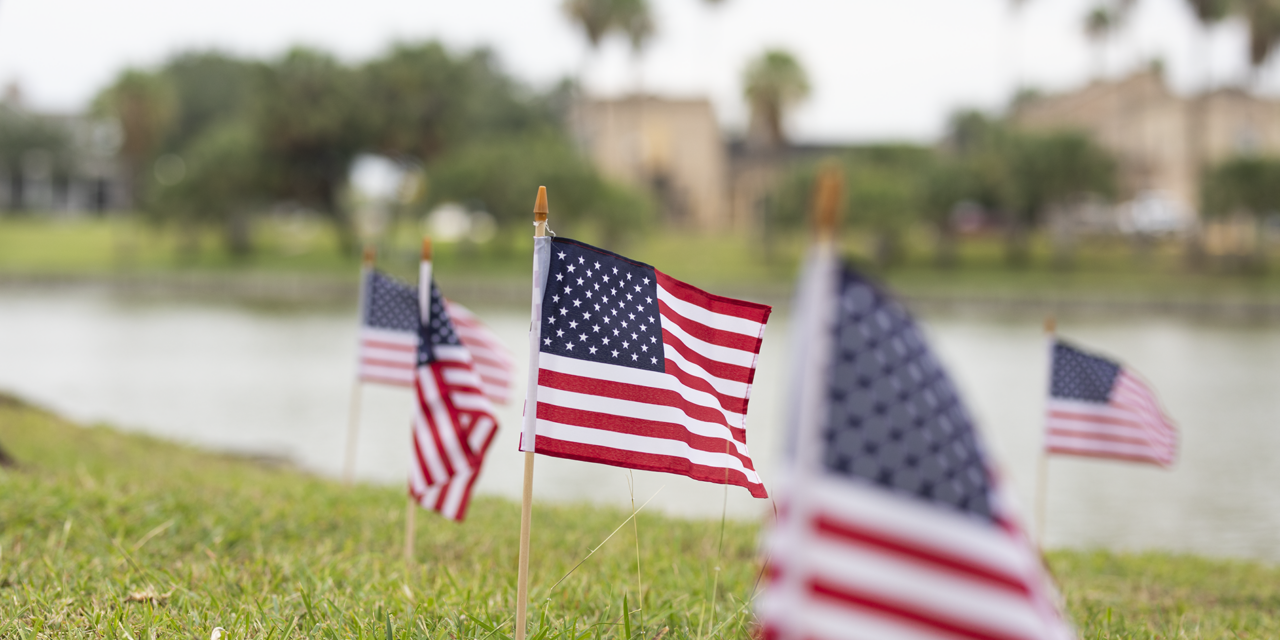
Texas Southmost College will honor the lives of the fallen heroes buried at Old Fort Brown Cemetery, as well as all military personnel who died while serving in the United States Armed Forces, with a special ceremony during its Flags on the Lawn event.
The event, part of TSC’s Centennial Celebration, will take place Friday, May 22, at 8:30 a.m. on the historic grounds of the former cemetery site at 1905 W. University Blvd.
During the ceremony, guests will learn about the historical significance of Old Fort Brown Cemetery, followed by a traditional 21-gun salute in tribute to the fallen heroes.
TSC will distribute U.S. flags for visitors to place on the historic grounds of the former cemetery site, where more than 4,000 flags will be displayed.
In 1911, the graves in the cemetery were disinterred, and the remains were moved to Alexandria National Cemetery in Louisiana.
“The headstones remained in place until the fort was sold,” said Hinojosa. “During that time, a contractor bid on the gravestones and used them on his building in downtown Brownsville. You can still see some of the cornerstones. A lot of the graves were used as part of the foundation. They remain there and are still visible in the downtown area.”
In the 1944, the fort was decommissioned. After that, the City of Brownsville and the Brownsville Independent School District (BISD) acquired the land as the new home for the college.
“Forty-eight acres went to what back then was Brownsville Junior College, which is now TSC, “Hinojosa said. “Seventy-five buildings out of the 250 that existed were given to the college. It established the core of the college’s campus.”
Hinojosa, an architect who takes great interest in the structural history of buildings, is especially impressed with Gorgas Hall.
“The college has been here at this location for 80 years and has utilized many of these historical buildings,” he said. “Like the hospital, which is now Gorgas Hall. It’s one of the most beautiful military hospitals in the U.S. with its vernacular structure. I couldn’t believe the beauty of the Spanish arches and New Orleans type of architecture that was built.”
Hinojosa says that after the area around the cemetery’s fort was later developed into a resort, the site’s history as a cemetery was gradually forgotten.
“At that time, the attraction was to come into this resort area where you could use the resaca, or the lagoon, to have your motorboats and to do paddlewheels,” Hinojosa said. “They had motels throughout the island itself, which was a little island paradise. So, the idea of a cemetery had been forgotten after that, with the headstones removed.”
Hinojosa commends TSC for raising awareness about the historical significance of Old Fort Brown Cemetery with its Flags on the Lawn event.
“Eighty years that this hasn’t been in my mind,” he said. “What the college is doing right now, remembering Memorial Day and the national cemetery that was there because the resort is not at that location, and the significance of what happened in 1846 would be incorporated into what the college has done during its time at this location.”
Members of the public are invited to join the TSC community at the Flags on the Lawn event.